Introduction
South San Jose is entering the most dramatic transformation it has seen in 40 years. Over $2 billion in active development is now in motion — new neighborhoods being built from scratch, century-old shopping centers being completely reimagined, transit lines extending deeper into the south end of the city, and state housing laws forcing seven-story buildings onto corridors where nothing has ever stood taller than a strip mall.
This is not a slow suburban shift. It is faster, denser, and more consequential for property values than anything the south side of the city has experienced in decades. Homeowners who understand where the development is concentrating — and what each project actually means — will be positioned for it. Those who don't will be surprised.
The south San Jose story spans everything from a neighborhood mixed-use village finally breaking ground to a 690-acre IBM research campus whose future is entirely unwritten. The range of what's happening here is unlike any other part of Silicon Valley right now.
In this article, we'll break down:
-
The Cambrian Village redevelopment — 18 acres and the most ambitious mixed-use project in the South Bay
-
Communications Hill Phase 3 and the arrival of its first walkable retail core
-
Two builder's remedy projects forcing density onto low-rise corridors
-
The Tamien Station affordable project that just opened — a proof of concept for what's coming
-
The East Ridge to BART light rail extension nearing completion
-
IBM's Almaden Research Center closing and what happens to 690 acres
-
Coyote Valley and Oakridge Mall: what's being protected and what's evolving
Cambrian Village: 18 Acres, 378 Units, and a Neighborhood Reimagined
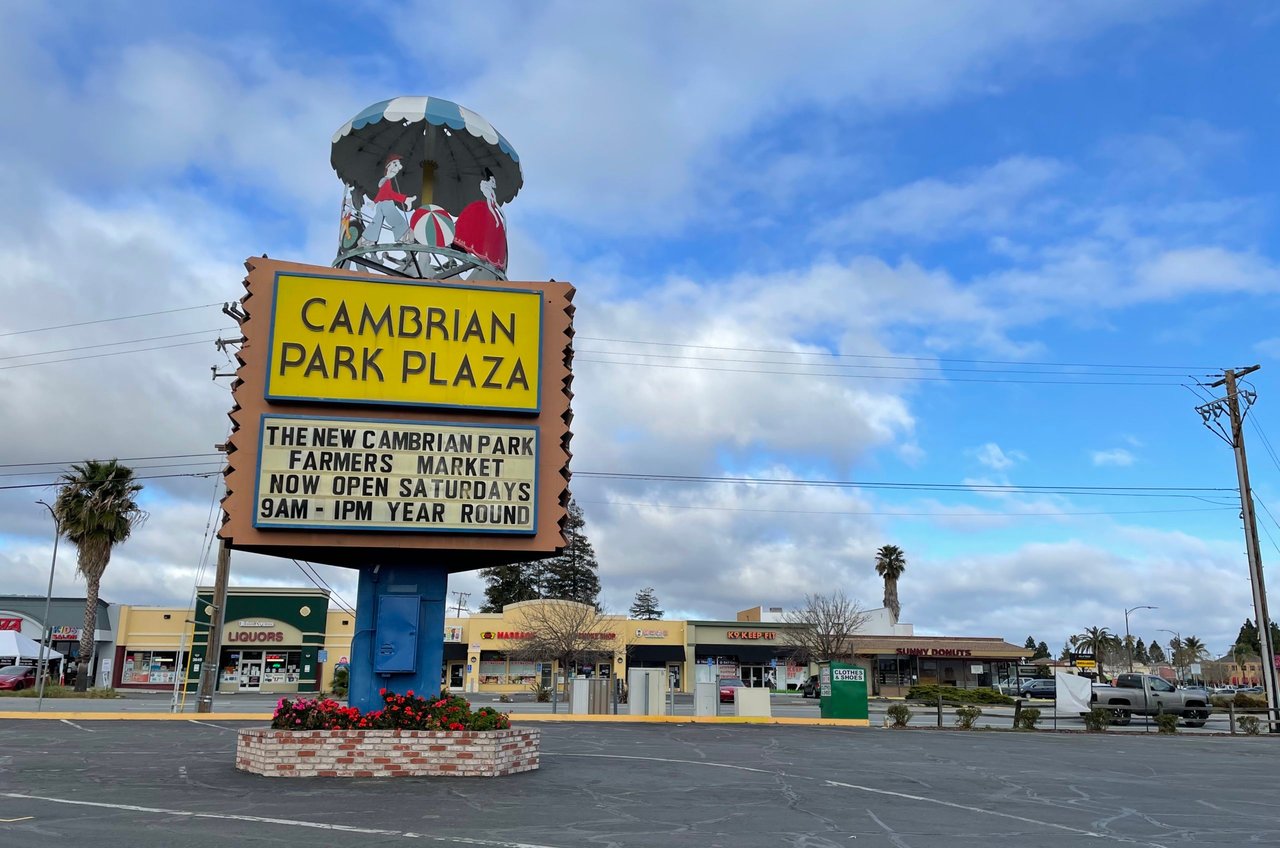
Most South San Jose residents know the spinning carousel at Cambrian Park Plaza on the corner of Camden and Union Avenue. That landmark has anchored the corner since the 1950s — a genuinely beloved piece of local identity. It is about to become something entirely new.
The approved plan for Cambrian Village is one of the most ambitious mixed-use redevelopments in the South Bay right now. The full scope across 18 acres:
-
305 apartments
-
48 single-family homes
-
25 townhomes
-
A hotel
-
Retail and restaurant space
-
4 full acres of public park
The developer recently applied to build the residential component first, moving on the housing before the permit window closes in 2028. There is no groundbreaking yet as of today — but approvals are already in place. The project is moving.
The reference point for what this could become is Santana Row: a walkable mixed-use center that fundamentally changed the lifestyle equation for its surrounding neighborhoods. Cambrian has always had strong fundamentals — excellent schools, good access to Los Gatos and Campbell — but it has remained deeply suburban with very low-rise development. Adding 378 residential units plus a hotel to a walkable commercial center changes that equation materially.
For single-family homeowners in Cambrian and West San Jose, this development is a net positive: more amenity activation, more foot traffic, more reasons for buyers to want to live nearby. For condo and townhome owners in the immediate vicinity, the picture is more nuanced — additional rental supply will create competition, and the net effect on resale value depends on how quickly the retail component fills out.
Communications Hill: Phase 3 and the First Walkable Core
Communications Hill has always had the bones of a great neighborhood — hilltop views, newer construction dating from the early 2000s, a distinctly residential character. What it has never had is a functional commercial core. That is changing.
KB Home is continuing construction of approximately 1,300 units across multiple phases on the hill. More significantly, the San Jose Planning Commission approved 33,000 square feet of retail and restaurants along Lean de Robles Avenue — the beginning of a genuine walkable neighborhood center, not a strip mall.
Right now, residents of Communications Hill drive down the hill for groceries and restaurants. When this retail component delivers, that changes. Walkable commercial access in a primarily residential hilltop neighborhood is a meaningful lifestyle upgrade — and lifestyle upgrades translate directly into sustained buyer demand.
For buyers looking for new construction single-family homes in the South Bay, Communications Hill is one of the very few places where that product exists today. The combination of new construction inventory, hilltop views, and an emerging commercial core makes this a neighborhood worth watching closely in the next 12–24 months.
Builder's Remedy: Two Projects Forcing Density Onto Low-Rise Corridors
California's builder's remedy provision kicks in when a city fails to certify its housing element — its approved plan for where new housing can go. When that happens, developers can bypass local zoning almost entirely and build at densities the city would never normally approve. Two projects in South San Jose are currently moving under this mechanism:
605 Blossom Hill Road — Directly adjacent to the Blossom Hill VTA light rail station. 239 market-rate units plus 89 affordable units. Currently in design review as of April 2026.
1000 South De Anza Boulevard — On the Cambrian/West San Jose border. Seven stories, 118 units on a low-density commercial corridor where nothing remotely that tall has previously existed.
Both projects are proceeding on corridors that, under normal zoning, would never see this kind of density. For residents nearby: additional traffic, additional school enrollment pressure, and a fundamentally changed streetscape are the realistic near-term consequences. The longer-term story is whether the retail activation that follows new density improves quality of life in those corridors — a question that plays out over five to ten years.
Tamien Station: Proof of Concept Is Now Open
At 1221 Lick Avenue, the Tamien Station Apartments just opened this year. 135 units, 100% affordable, built by Core Companies. People are already moving in.
The reason this project matters beyond its unit count: it is no longer theoretical. Transit-oriented affordable development at a VTA station in South San Jose is built, financed, and occupied. That proof of concept changes the calculus for future projects along the same lines.
Capital and policy follow transit corridors. Every VTA rail stop, BART station, and Caltrain platform in South San Jose now has a demonstrated model for what gets built there. Expect this pattern to repeat — and expect it to accelerate as the East Ridge to BART connection comes online.
East Ridge to BART: Transit Extension Nearing Completion
The East Ridge to BART Regional Connection — a VTA light rail extension running along the Capitol Expressway corridor — has been under construction long enough that most South San Jose residents have simply accepted the disruption as permanent. It is not permanent. The target completion window is around 2028.
The construction trenches along Capitol have displaced businesses and created years of friction for the surrounding commercial corridor. That phase is nearly over. When the line opens, residents of East and South San Jose gain materially improved public transit access to the broader regional network.
Will light rail access directly lift home prices? The data on that is mixed. What it reliably does is attract new housing development to the station areas — and that supply, in turn, shapes the neighborhood character of every corridor it touches for the following decade.
IBM Almaden Research Center: 690 Acres and No Answers Yet
This is the story generating the fewest headlines while carrying the most long-term consequence.
IBM is closing its Almaden Research Center at 650 Harry Road and relocating its researchers to the Silicon Valley Lab at 555 Bailey Road in Coyote Valley. The Almaden facility is historic — this is where IBM pioneered the world's first hard disk drive and the relational database. It is not just a piece of real estate; it is a landmark of the tech industry's original golden age.
The question that has no answer yet: what happens to 690 acres in Almaden Valley, a neighborhood where developable land is essentially zero?
The site is large enough to constitute a small town. The most likely outcome over a long horizon is mixed-use redevelopment — some combination of housing, open space conversion, and potentially new commercial. For current Almaden Valley homeowners, a residential development of meaningful scale on that site would be the most significant change to their neighborhood in decades.
What homeowners should do right now:
-
Begin tracking how the site is categorized in San Jose's general plan
-
Watch for any rezoning applications or pre-application inquiries
-
Understand that a decade or more may pass before any development materializes — but the direction of travel matters now
Coyote Valley and Oakridge: What's Being Protected and What's Evolving
Two final stories that reflect what South San Jose values — and what it's defending.
Coyote Valley — The San Jose City Council has blocked commercial warehouse development in Coyote Valley and rezoned significant portions from industrial to agriculture and open space. The protected area totals 7,000 acres at the south end of the city — a critical wildlife corridor connecting the Santa Cruz and Diablo mountain ranges.
For Santa Teresa and Almaden homeowners, Coyote Valley is not background noise. It is the open space buffer that keeps South San Jose feeling structurally different from the rest of Silicon Valley. As long as that protection holds, the low-density character of the southern neighborhoods is preserved. If it ever changes — through future political shifts or state override — the development pressure that would follow would be substantial.
Oakridge Mall — Still standing, still evolving. The center ranks among the top 20 cinema locations in the country by volume, which drives consistent foot traffic. Expect ongoing tenant refreshes and potential mixed-use proposals on the outer parking lots — a pattern that has played out at Valley Fair and is accelerating at malls nationally. Whether Oakridge pursues that path is worth monitoring.
What This Means for South San Jose Homeowners
The development is real, it is concentrated, and it is not evenly distributed across the city.
Single-family homeowners in Blossom Valley, Capehart, Almaden, and Santa Teresa are generally well-positioned. The state housing mandates and builder's remedy projects are concentrating density along transit corridors and commercial edges — not in established single-family neighborhoods. New walkable retail activations at Cambrian Village and Communications Hill will likely add net value to those surrounding areas over time.
Condo and townhome owners face a more competitive environment ahead. New rental inventory is coming to multiple corridors simultaneously. Appreciation in this product type has been limited historically, and additional supply does not improve that outlook. Owners in this segment who are considering a move should assess timing carefully.
Buyers looking to enter the market — South San Jose single-family homes represent one of the strongest long-term value cases in Silicon Valley right now. The combination of infrastructure investment, transit improvement, commercial activation, and constrained single-family supply creates the conditions for sustained appreciation. The next five years will bring more construction activity than the previous four decades combined — but the homeowners who buy before that wave completes will be the ones who benefit most from it.
Conclusion
South San Jose is no longer the quiet suburban counterpart to the rest of Silicon Valley. The development pipeline now in motion — from Cambrian Village to the IBM campus question to the builder's remedy towers on De Anza — represents a structural shift in how this part of the city grows. State housing law is accelerating timelines that local politics would have delayed for another generation.
The framework for homeowners is clear: single-family is protected and well-positioned, condos and townhomes face increasing competition, and buyers who understand the geography of this transformation have a meaningful advantage over those relying on broad market narratives.
As a data-driven Bay Area real estate advisor ranked in the top 0.5% nationally with over $80M in annual production, I help clients analyze not only properties — but the long-term direction of the markets they're buying into.
[youtube: https://www.youtube.com/watch?v=KTRKwT70Z0g]
📩 Subscribe to the newsletter for weekly Bay Area development updates and Silicon Valley real estate insights.
📅 Schedule a consultation to discuss your real estate goals and investment strategy across the Peninsula and Bay Area markets.