Milpitas’s Housing Market Is About to Change Forever
For years, Milpitas was often overlooked compared to Sunnyvale, Mountain View, and Palo Alto. Many buyers viewed it as a convenient commuter city with strong schools and relatively better affordability, but not necessarily a place undergoing dramatic transformation.
That perception may be outdated.
Milpitas is now seeing one of the largest coordinated infrastructure and redevelopment efforts in the South Bay. The city is planning more than 7,000 new homes, investing $90 million in an innovation campus, extending major road networks, and attracting advanced manufacturing employers such as Rivian.
When transit, housing, schools, jobs, and public infrastructure all move in the same direction, it often creates a long-term demand story that extends well beyond a typical market cycle.
Here’s what buyers, homeowners, and investors should know about the projects reshaping Milpitas through 2030 and beyond.
The Biggest Story: The Milpitas Metro Specific Plan
The Milpitas Metro Specific Plan (MMSP) is the city’s master blueprint for transforming the area around the Milpitas BART Station and Great Mall into a walkable, transit-oriented urban district.
The full vision includes:
- 7,000+ residential units
- 993,000 sq ft of office space
- 287,000 sq ft of retail
- 340 hotel rooms
- $56 million in infrastructure funding
The plan covers roughly 437–510 acres in southern Milpitas and is divided into several subdistricts, including:
- Great Mall
- McCandless
- Piper
- Tango
- Innovation District
Think of this as Milpitas’s version of what parts of North San Jose looked like before their major growth phase.
Why it matters for real estate
Housing alone doesn’t necessarily create outsized appreciation. The bigger opportunity comes when jobs, retail, and transit follow the housing, creating a true neighborhood ecosystem rather than a collection of apartment buildings.
The reality check
This plan has been in discussion since 2008. Large-scale specific plans often take 10–20 years to fully build out, so buyers should view this as a long-term transformation rather than an overnight catalyst.
Great Mall & BART: A New Transit-Oriented Neighborhood
One of the most active projects is the redevelopment of the VTA Great Mall Station area.
In 2026, a developer was selected to transform the former bus station and park-and-ride site next to Milpitas BART.
Planned features include:
- Up to 400 new homes
- Affordable family housing
- Senior housing
- Mixed-use retail
- Improved pedestrian connections
- Multi-phase transit-oriented development
VTA is also advancing plans for additional high-density housing on nearby vacant parcels.
Why this is significant
The southern corridor is evolving from a primarily industrial and retail zone into a genuine residential neighborhood with daily amenities and transit access.
For existing homeowners in nearby communities, that shift can improve neighborhood perception, walkability, and long-term desirability.
The $15.7 Million Road Project That Could Matter More Than People Think
Infrastructure is often overlooked in real estate analysis, but it can have a major impact on property values.
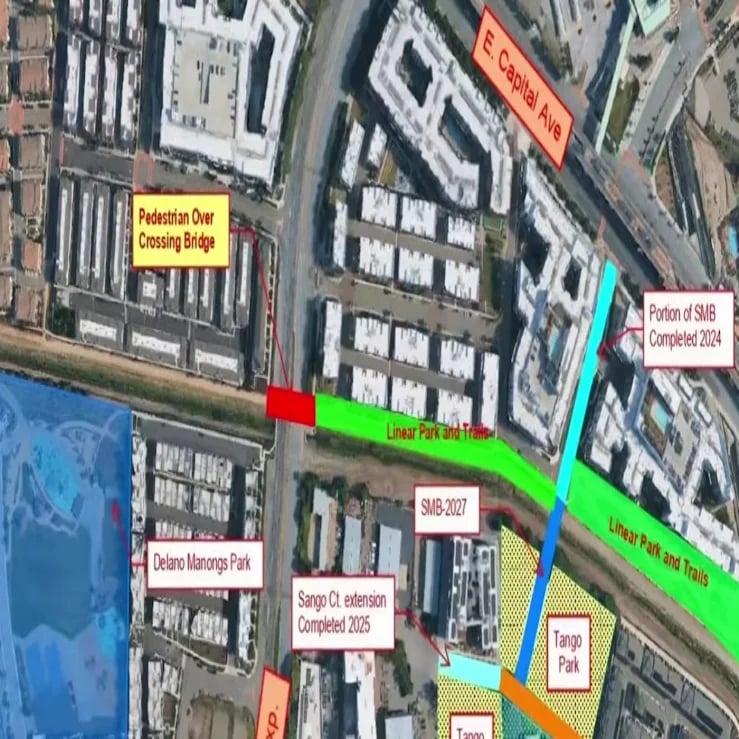
Milpitas is currently building the South Milpitas Boulevard Extension, a $15.7 million project that includes:
- A new roadway connection
- A bridge over the Penitencia East Channel
- Improved access between BART, Great Mall, schools, and new residential neighborhoods
- A future community park with tennis courts, gardens, playgrounds, and picnic areas
The final bridge phase is expected to begin construction in 2026 with completion targeted for early 2028.
Why walkability matters
Being able to walk from a home to BART, parks, retail, and schools without crossing major arterial roads is exactly the kind of infrastructure improvement that tends to support long-term value growth.
Short-term downside
Residents near the construction corridor should expect 12–18 months of noise, dust, traffic adjustments, and temporary inconvenience.
Milpitas Is Trying to Build a Real Downtown
Ask most longtime residents where downtown Milpitas is, and you’ll likely get a shrug.
The city is attempting to change that through the Gateway Main Street Specific Plan, which covers roughly 600–1,000 acres along Main Street and Calaveras Boulevard.
The vision includes:
- Mid-rise housing
- Ground-floor retail
- Pocket parks
- Protected bike lanes
- Streetscape improvements
- New business attraction programs
This is Milpitas’s answer to the criticism that it lacks a true urban core.
My take as a local observer
The corridor has historically been more functional than vibrant. While the plan is ambitious, the success of a downtown depends heavily on whether restaurants, retail, entertainment, and foot traffic actually materialize over the next decade.
A $90 Million Innovation Campus Just Broke Ground
Education is another major piece of the story.
Milpitas Unified School District is expanding its Innovation Campus, a nearly 100,000-square-foot workforce and education hub funded through local bonds and state matching grants.
The project includes:
- Workforce development facilities
- Early childhood education space
- All-electric, solar-powered buildings
- Technology-focused learning environments
- Completion targeted for summer 2027
For families, this signals a continued commitment to education and workforce preparation, which remains one of the strongest drivers of housing demand in the South Bay.
Rivian Chose Milpitas—But There’s a Catch
In 2025, Rivian established a facility at 755 Yosemite Drive focused on production, R&D, and operations.
The partnership is meaningful because the city also entered into a sales-tax sharing agreement projected to generate nearly $9.4 million in revenue.
Why this matters
Advanced manufacturing jobs tend to be higher-paying and can create spillover demand for housing, services, and supporting businesses.
The caveat
The EV industry is experiencing slower growth and periodic layoffs. Rivian’s long-term expansion trajectory is not guaranteed, so buyers should view this as a positive but not a certainty.
The Underappreciated Story: Advanced Manufacturing
Many people still think of Milpitas primarily as a retail or commuter city.
In reality, it has become one of Silicon Valley’s strongest advanced manufacturing hubs.
The city has seen:
- $450+ million in recent development investment
- 1+ million sq ft of manufacturing and R&D space under construction or renovation
- Continued demand from semiconductor, hardware, and industrial technology companies
This economic base is important because it provides job diversification beyond traditional software employment.
A Warning Sign: The City’s Budget Deficit
Not everything is bullish.
Milpitas is currently managing an estimated $16 million structural deficit and has experienced significant leadership turnover, including changes in city management and economic development leadership.
Why does this matter?
Because infrastructure promises are only as strong as the city’s ability to fund and deliver them. Budget pressures can slow projects, delay timelines, or reduce the scope of planned improvements.
This is one of the key risks investors should continue monitoring.
What This Means for Homeowners
If you already own property in Milpitas, the next 4–6 years could be particularly important.
The combination of:
- BART-oriented redevelopment
- New road infrastructure
- School investment
- Job growth
- Retail activation
- Mixed-use zoning
creates a meaningful long-term demand backdrop for many neighborhoods.
Which Property Types Benefit Most?
Single-Family Homes
Historically, this has been the strongest-performing asset class in Milpitas.
Limited supply, strong school demand, and commuter convenience continue to support long-term appreciation.
Condos & Townhomes
This segment may face more headwinds.
With thousands of new housing units planned—including many rental and high-density projects—condos and townhomes could see more competition and slower appreciation than detached homes.
For buyers, that may create opportunities. For current owners, expectations may need to be adjusted.
Why Milpitas Remains Strategically Positioned
One reason Milpitas has consistently held value is geography.
It acts as a bridge between:
- San Jose
- Fremont
- Sunnyvale
- Mountain View
- Palo Alto
Importantly, many commuters can reach major employment centers via 237 and 680 without crossing a toll bridge, which remains a significant cost and convenience advantage.
Final Thoughts
Milpitas is no longer just a convenient South Bay suburb—it is becoming a multi-decade redevelopment story.
The city is simultaneously investing in transit, housing, schools, roads, workforce development, and advanced manufacturing. That combination is relatively rare in Silicon Valley and has the potential to reshape how buyers perceive the market over the next decade.
That said, the timeline matters. Many of these projects are 2026–2030 catalysts, not immediate overnight transformations. Execution risk, funding constraints, and economic conditions will determine how much of the vision ultimately becomes reality.
For buyers who believe in long-term South Bay growth, especially around transit and employment centers, Milpitas is a market that deserves much closer attention than it has received historically.
Frequently Asked Questions
Is Milpitas a good place to buy a home in 2026?
For many South Bay buyers, yes. Milpitas offers strong schools, BART access, proximity to major tech corridors, and significant infrastructure investment that could support long-term demand.
What is the Milpitas Metro Specific Plan?
It is the city’s master redevelopment plan for the BART/Great Mall area, including more than 7,000 homes, office space, retail, hotels, and public infrastructure improvements.
Will all 7,000 homes be built soon?
No. The plan is a long-term vision that could take 10–20 years to fully build out, depending on financing, market conditions, and regulatory approvals.
Are condos or single-family homes the better investment in Milpitas?
Historically, single-family homes have shown stronger appreciation. Condos and townhomes may face more supply competition as additional high-density housing is delivered.
How does Rivian affect the housing market?
Rivian adds advanced manufacturing jobs and tax revenue to the city, which is generally positive for local demand, though the company’s long-term expansion is not guaranteed.
Call to Action
Whether you’re buying, selling, or evaluating a long-term investment in Milpitas, understanding which neighborhoods sit closest to the BART corridor, Innovation District, and future mixed-use developments can make a significant difference in your outcome. The Spencer Hsu Real Estate Team specializes in data-driven South Bay real estate and can help you build a personalized strategy around your budget, timing, and long-term goals.